The Truth versus lies
Last week, I wrote for the first time in 1.5 years, “A Student of Wisdom”. I never write here more than once a week. If you want more, it’s in my journal. I wrote last week about “The great illusion of life and my words,” and about friendship. I asked, “Are friends tearing us away from ourselves?”
Thank you for your many comments and private emails. Keep them coming!
When a lie is obvious, we feel the Truth exists.
We all experienced lies; we know how they feel. We likely experienced lies on both sides, as a receiver and as a source, hopefully unconsciously. We might have just repeated something not true because we did not know.
For example, I ordered a product and paid 100% of the price. It was never delivered to me, and it has been six months. The supplier kept telling me it was coming until he finally admitted the truth, that he used my money for something else and did not pay his own supplier, which is why I did not get the product. The lie was obvious (the product did not come), and the truth was finally said.
We live in a world of lies. Just look at what our elected politicians are; they are professional liars and machines promising what they generally never deliver, and often deliver the opposite.
I already wrote about a simple business example; it is common. Advertising is mostly a lie, showing people only what they want to hear and hiding any issues with the products or services.
The truth (I am not using a capital “T” by design) is rare. Add AI-generated content to that, and now news and social media are flooded mostly with lies. Instagram is full of posts of people showing their beautiful lives (or even faking them) while they are desperate or empty inside.
The bigger the outside show, the highest emptiness or depression inside.
I have been there; I haven’t been immune either, and being conscious of it is step one, which is why I don’t post much on social media anymore.
Why so many lies?
I feel that it’s childhood programming. It’s based on fear. Fear of not being good enough, not successful enough, not wealthy enough, etc. It started with our parents telling us our school marks weren’t good enough or that we misbehaved, sometimes with associated punishments. This fear carries through our whole life if we don’t become aware of it.
We exaggerate success (or even fake it), reframe stories, and minimize failures, all because of fear.
If everyone and every business does it, is that the only solution to live in this society to do the same? I want to believe there is another way.
The truth versus the Truth
At first, the truth seems obvious, doesn’t it?
2+2 = 4. Fire is hot, and ice is cold. This table is strong (quantum physics says there is no table if I understood well). I graduated from that business school.
All ancient texts tell us that saying the truth is essential, and we all agree with that, yet most people prefer lies.
The truth is often inconvenient, rude, brutal.
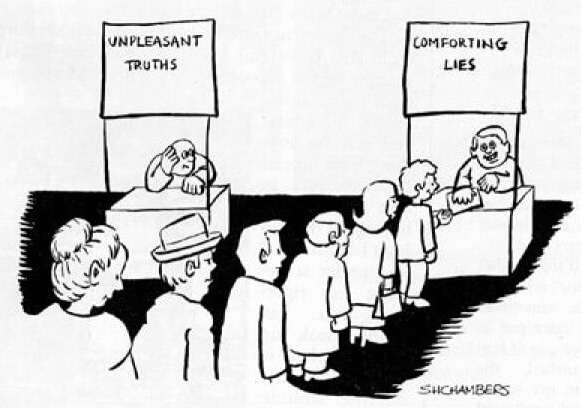
I have told people several times, “This is a lie,” and it ends badly in most cases.
Many people aren’t able to receive the truth and prefer to stay with everyone’s lies, often their own. I am trying to see my own constantly.
Silence is often a good choice rather than saying the truth to avoid people getting angry or… losing friends you care about. I encourage you to read “The Courage to be Disliked,” which I have read a few times and will read again, helping you say things as they are when you accept that losing friends is okay.
Is there only one Truth, or does everyone have some version of it?
In other words, is the expression “You have your Truth, and I have mine”, which I heard many times, a common answer, valid?
The common ground in philosophy is that there is only one Truth, says my friend who teaches philosophy.
This also feels true to me. We are all able to distinguish between truth and falsehood. We might fail, but we can.
Learning to be silent is safer than saying the truth. Silence also speaks.
Nobody is here to really tell you what to do, says Krishnamurti.
Why should we trust what anybody says? “I think that the psychological or religious guidance is totally wrong,” says Krishnamurti while giving guidance himself! To be fair, he constantly repeats not to trust him either, and I often listen to his talks; he speaks truth to me, especially when it is inconvenient.
The world believed the Earth was flat for longer than it believed it wasn’t.
AI said, “The Earth as a sphere was discovered by Ancient Greek philosophers, starting with Pythagoras in the 6th century BC, and confirmed by Aristotle in the 4th century BC through empirical evidence. By 240 BC, Eratosthenes had accurately calculated the Earth's circumference, and educated people have widely understood the Earth is a sphere for over 2,000 years.”
What is 2,000 years at the scale of humanity? The first homo sapiens would have evolved in Africa 300,000 years ago. The universe would be 13.8 billion years old; what is 2,000 years?
Who knows? With the pace at which science evolves, we will likely discover major lies we still believe in. Or maybe technology is just making the lies worse, or both at the same time. It has never been as easy as today to manipulate the masses.
The Truth
AI says:
“Most traditions locate Truth not as a proposition but as a state of being or direct experience — something approached through purification, practice, or grace, not argument.
The Hindu Sat (pure Being) is Truth
The Buddhist Dharma is the nature of things as they actually are
The Taoist Te is alignment with what’s real
The Jewish Emet (truth) is one of the pillars holding up the world
Christ says I am the Truth — Truth is personal, not abstract
The Islamic Haqq is simultaneously Truth and one of the 99 names of God
The consensus: Truth is not just known — it is lived, embodied, or encountered.”
I fully agree with this last statement. The Truth cannot be put into words; it has to be experienced.
As far as I am concerned, I experience it in nature, rarely with humans or in a city. In other words, I love being in nature because it is the truth. I prefer watching a sunrise to taking the best Instagram shot of it, even though I sometimes do. I prefer sitting with a tree and watching how it grows, especially the older ones; it is the truth.
I also like working with the indigenous despite encountering many human lies, too, but they can be honest lies. They generally don’t explain what a ceremony is or what their songs do; they invite you to experience them and possibly sing them. Same with Kirtan or Buddhist mantras.
I have learned to sing, and I am still learning many indigenous songs. When I sing, I feel that “Truth” and don’t need to explain it to myself. If I feel good, I sing; if I feel “bad”, I sing too. The ancient songs feel true to me and bring me that feeling. That is enough for me to reconnect with the “Truth”, whatever it might be.
I am curious to read what you think about lies and truth. Please comment or email me back if you'd like.
Becoming aware of this truth versus lies makes speaking and writing very difficult. Even though I prefer learning from my own experiences, especially when I say something “wrong”, I also like to read.
I have only read two good books about “right speech” or how to speak. Do you have any other good books you recommend? I prefer philosophy or ancient knowledge to psychology, even though that is sometimes good too. Thanks!
The Art of Communicating from Thich Nhat Hanh, which I have just re-read again,
Nonviolent communication, which I should read again
This is lovely, an honest journey through the forest of not knowing.
My attraction is to the Jewish structure of Emet - twin pillars that support the world. As you’ve mentioned, absolute truth is rare but it feels like Lies and Truth are twin concepts that rely on each other to create structure - without that tension the earth topples.
Dan Ariely’s work on “Why we Lie” is nice because it supports and humanizes something almost uniquely human - lying. Ironically, he was busted for faking results. Everyone lies, even the experts.
Bad lies are deceptive, intentional and coercive. Good lies are told to protect children or to create art or fiction.
The good lie relies on knowing the truth but pretending in something else, the possible. In literature, the audience’s participation is required for the “Willing suspension of disbelief”
Thank you for this weekly gift. Here’s a related piece from a couple years ago - it talks about the twinned concepts of truth / untruth and Shibboleths - also how I got my aboriginal name. Enjoy!
https://reubensteiger.substack.com/p/the-dogma-catastrophe?r=3bgxr&utm_medium=ios
I live with music just there, as a child it was something I always assumed everyone has. Many people do have this, others wait for the radio, or whatever ceremonial, concert, band, car has it. As a child I had internal melodies almost always "on" and met people as I grew who also had it, the music in the mind. When I write now, I hear it in the words if they are there. Your writing is stimulating truth in songs, songs in truth :) - they are there.